
Knee replacement: from the decision to recovery
When wear in the knee significantly limits daily life, knee replacement may be a treatment option. The decision is based on pain, function, examination and your needs.
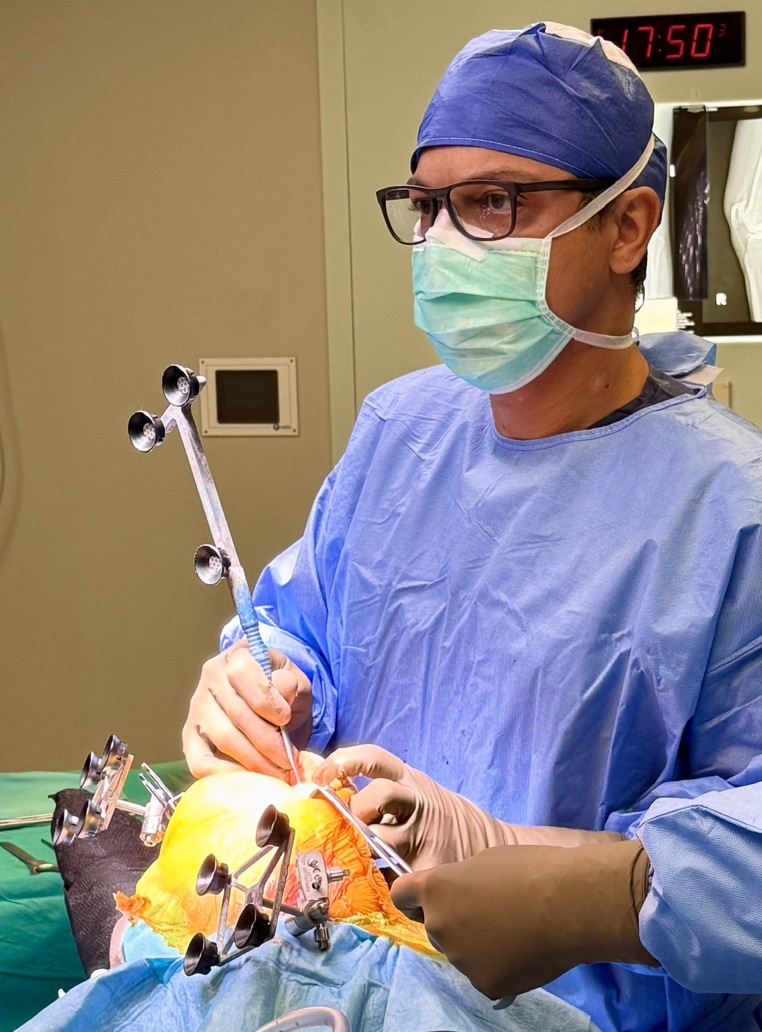
What does knee replacement replace?
Knee replacement replaces worn joint surfaces with implants. The whole knee is not removed. Metal components and a special plastic insert form the new surfaces on which the joint moves.
The most common cause is knee osteoarthritis (In Greek). Assessment establishes whether the pain really comes from the joint and whether surgery may help.
When is it worth discussing surgery?
Knee replacement is considered when pain and stiffness substantially affect walking, stairs, sleep or self-care and appropriate non-surgical treatment does not provide enough relief.
An X-ray alone does not determine the need for surgery. Movement, stability, deformity, general health and your expectations are considered together. See also the non-surgical treatment options.
Which operation suits the pattern of wear in the knee?
Total knee replacement
This is used for more extensive wear. Implant selection and planning are tailored to the anatomy, ligaments and needs of the knee.
Partial knee replacement
This may be discussed when arthritis is limited to a particular compartment and criteria for movement and ligament function are met. If wear progresses in other parts of the knee, further surgery may be needed later.
See the comparison of partial and total knee replacement (In Greek), together with the explanatory illustration.
Where does robotic assistance fit in?
The choice between total and partial knee replacement and the choice of an assistance technique are discussed separately. You can read about robot-assisted knee replacement (In Greek) and prepare your questions with the guide to robotic or conventional joint replacement (In Greek).
What is needed before surgery?
Preoperative assessment includes a review of general health and a discussion with the anaesthetist. Report all medicines, allergies, previous blood clots and any infections. Do not change your medication yourself.
Arrange help at home and discuss the plan for mobilisation, pain relief and blood clot prevention. Before leaving hospital, you should know how to move safely and whom to contact if a problem arises.
Rehabilitation continues after discharge
Mobilisation starts early, when your condition allows, with a walking aid and guidance. Returning home depends on safe walking, pain control and the support available to you.
Movement, strength and stamina improve gradually. Swelling may persist and full recovery takes months. Driving and work resume according to your progress and your team's advice.
What outcome is realistic?
The aim is to reduce pain and improve everyday function. Outcomes vary between patients; pain or stiffness may remain.
Possible complications include infection, blood clots or pulmonary embolism, bleeding, nerve injury and problems with stability. Over time, implants may wear or loosen and revision surgery may be needed. Discuss your personal risks and the plan to reduce them.
When is urgent assessment needed?
After surgery, fever, wound discharge or increasing redness and pain require immediate contact with the surgical team. New calf pain and swelling require urgent assessment.
Sudden breathlessness or chest pain require emergency help. In Greece, call 166 or go to a hospital Emergency Department. Do not drive.
Frequently asked questions
Is an X-ray enough to decide on knee replacement?
Is partial knee replacement suitable for everyone?
When can I return to my activities?

Medical review: Georgios Petridis, MD, MSc
Orthopaedic Surgeon · Knee surgery and knee replacement.
View biographyWhat does your knee need?
Bring your test results and discuss your pain, difficulties and priorities.