
Total knee replacement
The damaged joint surfaces are replaced when the pattern and extent of arthritis justify a total replacement. Robotic assistance can support planning and bone preparation.
Knee replacementRobotic assistance adds digital planning and guidance to selected knee and hip replacement procedures. The surgeon carries out the operation and makes the decisions; the system helps put the surgical plan into practice.
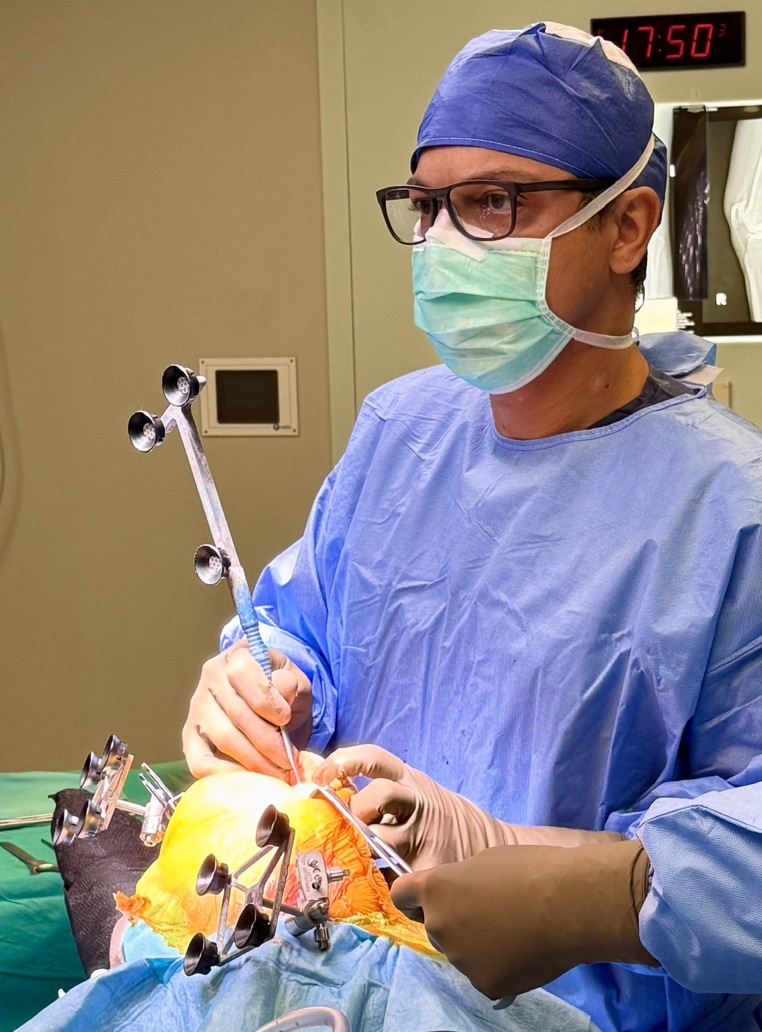
Joint replacement is considered when arthritis causes persistent pain and substantial limitations in daily life despite appropriate non-surgical treatment. The decision brings together symptoms, examination, imaging and the patient's goals. The availability of a robotic system does not, on its own, mean an operation is needed.
The damaged joint surfaces are replaced when the pattern and extent of arthritis justify a total replacement. Robotic assistance can support planning and bone preparation.
Knee replacementIn selected patients with arthritis limited to one compartment and appropriate ligament function, a partial replacement may be an option. Choosing partial or total replacement is a separate decision from choosing robot-assisted or conventional surgery.
Partial or total knee replacement (In Greek)For a hip that needs replacement, robotic assistance can support the surgical plan and the preparation and positioning of components, depending on the platform. It does not determine the surgical approach or make every patient suitable for the same technique.
Hip replacement optionsThe Mako system uses a pre-operative CT scan to create a three-dimensional model for planning the procedure. In theatre, registration links the patient's anatomy with the digital plan. The surgeon controls the instruments; the robotic arm provides guidance within the planned boundaries during bone preparation.
Other platforms work differently. The need for a CT scan, the instruments used, the procedures supported and the available implants vary. It is therefore useful to ask which system is proposed and why it is appropriate for the specific joint.
The plan is not a substitute for surgical judgement. Checking movement and stability, making adjustments and assessing the final result remain the surgeon's responsibility.
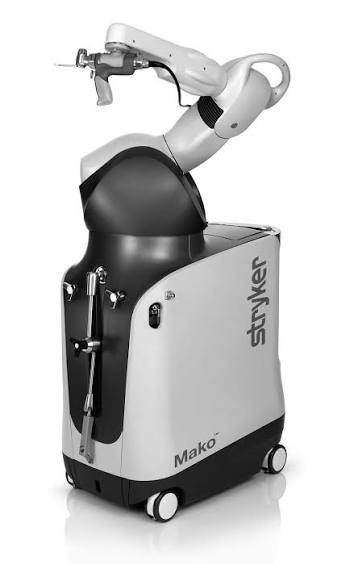
Detailed planning and controlled execution are important features of robotic assistance. More precise measurements do not automatically mean less pain, a faster recovery or a longer-lasting implant for every patient.
The evidence needs to be considered separately for total knee, partial knee and hip replacement, and for the particular system being used. Findings from one operation should not be presented as proof for every robotic procedure. Conventional joint replacement remains an established option.
Why an operation is being considered, the alternatives, what robotic assistance might add in this case, the team's experience, the possible risks and the full cost. A technology label alone is not enough to make an informed choice.
More detailed comparisons are available in the robotic versus conventional joint replacement guide (In Greek).
Robotic assistance does not remove the need for pain management, wound care, safe mobilisation or rehabilitation. The care team advises when and how to start walking, whether a walking aid is needed and how to progress exercises.
Discharge depends on safe mobility and the person's post-operative condition. Returning to work, driving and sport is individualised. The word “robotic” does not, by itself, define a fixed recovery date.
See the Patient Academy for practical preparation and recovery guidance, or explore the knee and hip hubs.
Joint replacement is still major surgery. Infection, blood clots, stiffness, persistent pain and implant-related problems remain possible. The relevant risks depend on the procedure and the patient's health.
Robotic systems can introduce additional considerations, including the radiation from a CT scan where required and complications at the sites of navigation pins, such as infection or fracture. The platform and compatible implants may also limit the available choices. These issues, and any additional cost, belong in the discussion before surgery.
The aim is not to use the newest tool in every case, but to choose a suitable and clearly explained treatment plan.
Fever, increasing pain, marked redness or discharge from the wound require prompt contact with the surgical team. New calf pain and swelling also need urgent assessment. Do not wait for a routine follow-up appointment.
Sudden breathlessness or chest pain, particularly with pain and swelling in the leg, requires emergency help. In Greece, call 166 or go to a hospital Emergency Department. Do not drive yourself.
Robotic-assisted knee replacement (In Greek) and robotic-assisted hip replacement (In Greek) provide more detailed information about each operation.

Orthopaedic Surgeon with a clinical focus on knee conditions, sports injuries, arthroscopy and joint replacement.
Read the doctor's profileBring your previous investigations and questions, and discuss your symptoms at an individual assessment.